Ask how affection feels welcome instead of assigning a fixed type
People may appreciate different forms of affection in different situations. A label cannot replace asking what feels welcome today. Explore specific preferences for words, touch, practical help and shared attention while keeping affection voluntary and avoiding the idea that one person’s preferred gesture must always be accepted.
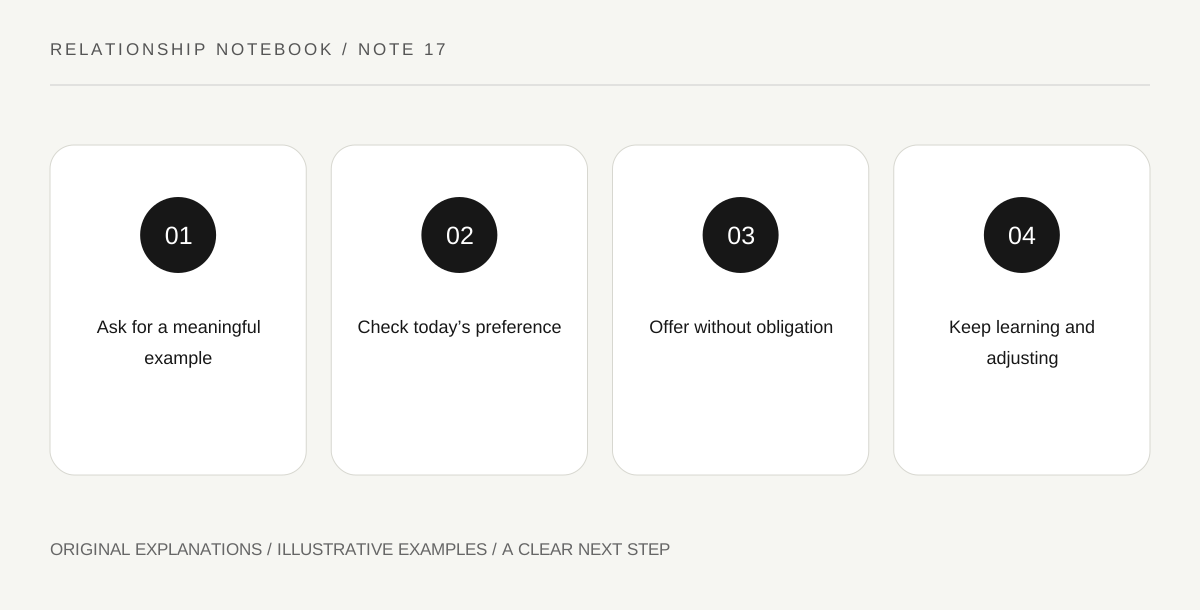
Original explanatory diagram. Read the full method and limitations below.
Ask for concrete examples
When did you recently feel cared for? invites a specific answer. It may reveal that a small attentive question mattered more than an expensive gift. Ask what made the moment meaningful rather than immediately classify the person into a permanent category.
Offer your own example without turning it into a demand. I appreciated that you remembered my presentation describes an experience. If you loved me, you would always anticipate my needs creates a test that leaves little room for ordinary mistakes, changing preferences or a partner’s different resources.
Consider context and capacity
A hug may feel welcome after one difficult day and overwhelming after another. Practical help may be appreciated if requested but intrusive if it removes a task the person wanted to handle themselves. The same gesture can carry different meanings depending on timing and choice.
Ask a small question in the moment: Would a hug help, or would you prefer space? A prior preference is useful knowledge, not permanent permission. Affection remains most informative when it responds to the person who is present rather than an old description of what their supposed type should want.
Offer care without creating a debt
A gift or kind action should not purchase attention, intimacy or forgiveness. If you want more shared time, ask for it directly instead of using generosity as a reason the partner must agree. Keeping requests separate from gifts makes both easier to understand.
Notice whether you are giving what the other person wants or what you enjoy giving. Both can have a place, but an unwanted elaborate gesture may burden the recipient. Scale the gesture to the person’s preference and your own capacity rather than assume greater effort always creates greater connection.
Build a flexible shared repertoire
Each person can name a few welcome gestures and a few that need checking first. Treat the list as a conversation aid, not a performance quota. The aim is more accurate attention, with space for spontaneous kindness and the freedom to decline.
Return to the conversation when routines or circumstances change. If one person repeatedly dismisses the other’s preferences, the issue may be willingness rather than a missing label. No framework can guarantee compatibility or substitute for respect in daily behavior.
Illustrative welcome gesture
After a demanding week, Priya says she values a quiet shared meal more than a surprise party. Her partner asks whether cooking together would feel good or create more work. Priya chooses a simple meal brought home and time without phones. On another week she wants to cook. The preference informs care without becoming a permanent identity.
Practical checks
Optional checkboxes save only in this browser.
Questions that come up
Should we identify one permanent affection style?
You can use a framework as a prompt if useful, but it should not override specific preferences or imply that a person always wants the same thing. Ask, observe and update your understanding.
What if my favorite gesture is not welcome?
Respect the answer and ask what would be welcome instead. You can also share what the gesture means to you without requiring acceptance. Care involves both your intention and the recipient’s actual experience.
References and scope
These sources support the factual background. Examples and exercises are original illustrative teaching material. References do not imply endorsement.
- RAINN: Consent 101 — Clear, voluntary, ongoing consent; respecting withdrawal and stopping when participation is uncertain.
- loveisrespect: What are my boundaries? — Personal, physical and digital boundaries; changes freely chosen; distinction between boundaries and control.
- loveisrespect: Respect in a healthy relationship — Equality, autonomy, honest communication, supportive behavior and respecting opinions.
- loveisrespect: Emotional boundaries — Different emotional pacing and trust developing through choices and behavior.