Make room for independent friendships while staying connected
A relationship can include close connection and time spent separately. Discuss how you want to stay connected without turning friends, hobbies or quiet time into evidence of rejection. A workable pattern protects each person’s independence and makes shared plans clear enough to rely on.
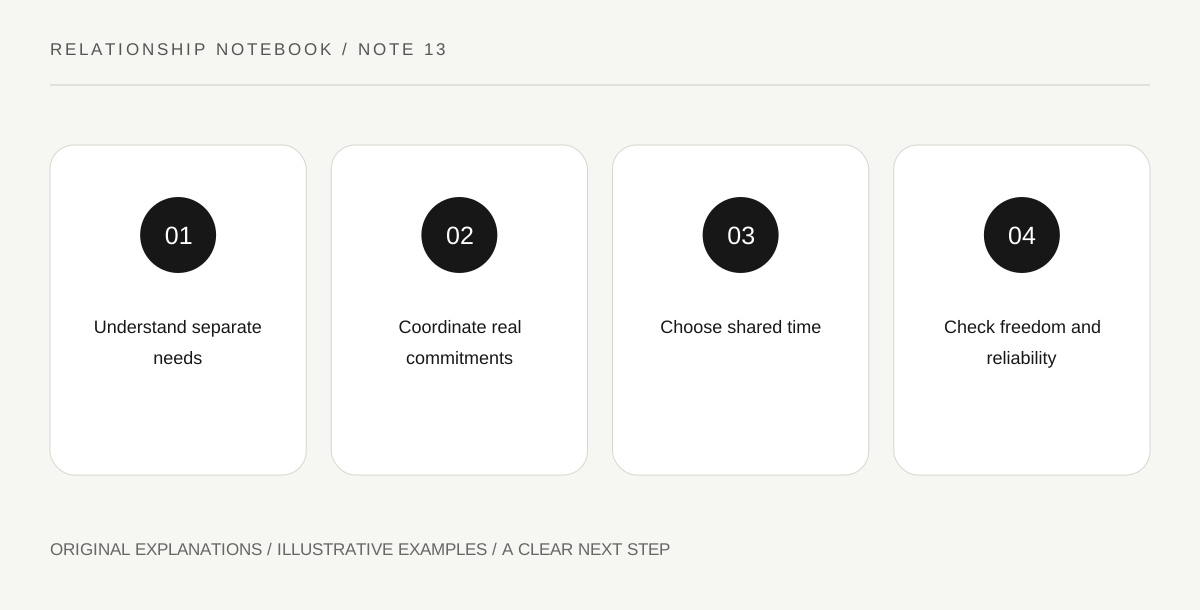
Original explanatory diagram. Read the full method and limitations below.
Name what separate time provides
Time with friends may provide belonging, creativity or continuity with a community. Time alone may provide rest or concentration. Ask what the activity contributes rather than assuming it is simply time taken away from the relationship. Independent interests do not have to compete with affection.
Likewise, wanting predictable shared time is not automatically possessiveness. State the experience you miss and the kind of plan that would help. The useful conversation considers both connection and independence instead of making one person defend every hour or making the other apologize for wanting companionship.
Distinguish coordination from permission
Telling a partner about a plan can help coordinate shared responsibilities. Asking permission to maintain ordinary friendships places the relationship in a different structure. Notice whether an update is freely offered information or a required approval process enforced by anger or punishment.
If you share practical commitments, explain which details affect them: whether you will be home for an agreed meal or available for a planned errand. Keep those logistics distinct from authority over the friendship itself. Coordination can be specific without granting either person control of the other’s social world.
Plan shared time without requiring total togetherness
Choose a realistic shared activity that both want, then preserve room for separate plans. A small reliable ritual may matter more than constantly being in the same room while distracted. Ask what feels connecting instead of measuring commitment only by hours spent side by side.
Avoid requiring every friend event to include the partner. Some friendships have their own context, and both people can maintain them. If an exclusion raises a specific concern, discuss that event directly rather than impose an all-events rule that gradually removes independent connection.
Keep the shared plan specific enough to protect it from accidental scheduling conflicts, while recognizing that an occasional necessary change can be discussed respectfully.
Watch for a narrowing world
A pattern of discouraging every friendship, creating conflict before social plans or demanding constant proof of whereabouts deserves attention. Isolation can be framed as devotion, but the behavior restricts choice. Seek outside perspective if maintaining ordinary support starts to feel unsafe or impossible.
For ordinary scheduling tension, review the arrangement after a few weeks. Are shared plans dependable? Can both take separate time without retaliation? The goal is not a universal number of nights apart, but a pattern that each person can freely accept and adjust.
Illustrative weekly rhythm
One partner wants a weekly music group; the other misses a regular evening together. They keep the music evening and choose a different night for a shared meal. They also clarify an existing errand commitment so it is not forgotten. The plan coordinates responsibilities without requiring permission to remain part of the music community.
Practical checks
Optional checkboxes save only in this browser.
Questions that come up
How much time apart is healthy?
There is no universal number. Consider preferences, responsibilities, wellbeing and freedom to choose. A useful pattern supports connection without requiring either person to give up independent interests and relationships.
Does wanting alone time mean losing interest?
Not necessarily. Ask what the time provides and discuss the actual pattern. A single preference for rest does not establish rejection, while repeated avoidance of agreed connection may need a separate conversation.
References and scope
These sources support the factual background. Examples and exercises are original illustrative teaching material. References do not imply endorsement.
- NHS: Maintaining healthy relationships and mental wellbeing — Listening, check-ins, time apart, boundaries, stress, conflict and permission to leave an unhealthy relationship.
- loveisrespect: What are my boundaries? — Personal, physical and digital boundaries; changes freely chosen; distinction between boundaries and control.
- loveisrespect: Respect in a healthy relationship — Equality, autonomy, honest communication, supportive behavior and respecting opinions.
- loveisrespect: Self-care — Individual interests, time for oneself and choosing personally useful support.