Build a long-distance contact rhythm that allows real life
Distance makes contact more deliberate, but more messages do not automatically create more connection. Agree on a rhythm that fits schedules and time zones, choose which conversations need focused attention and decide how to handle missed plans without treating constant availability as proof of commitment.
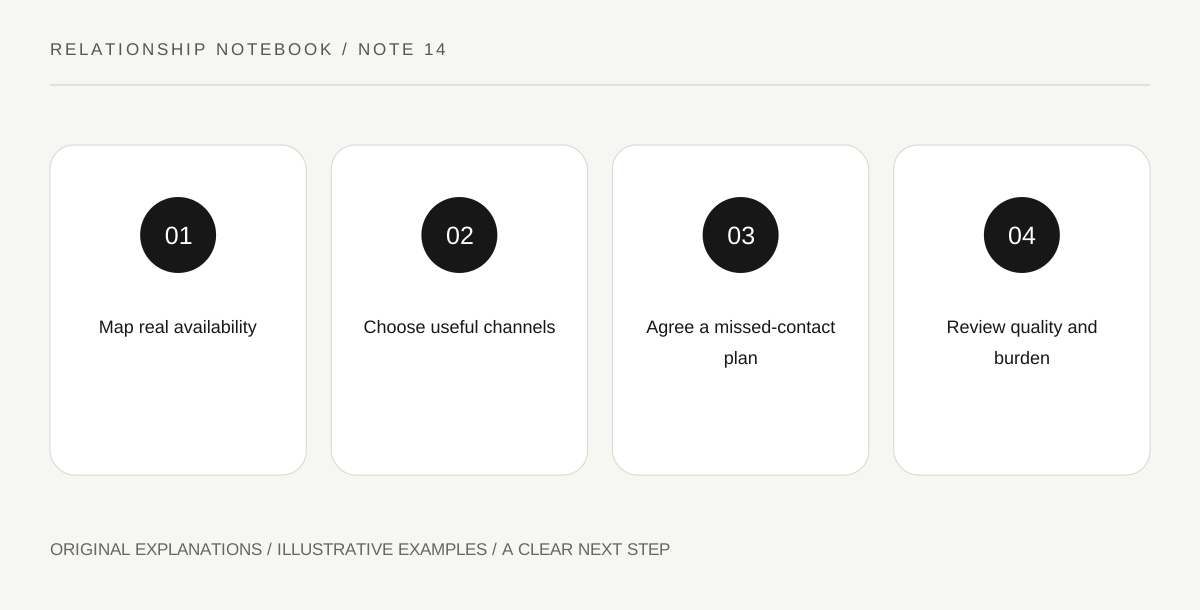
Original explanatory diagram. Read the full method and limitations below.
Map actual availability
List work, study, sleep and other commitments in each person’s local time. Identify a few overlapping windows instead of assuming one partner can always adapt. A late call that feels convenient in one location may repeatedly cost the other person sleep or private time.
Use the map to choose a realistic baseline, not a surveillance schedule. People can have unplanned demands and ordinary time away from a phone. A contact rhythm should help both anticipate connection while preserving the freedom to live locally rather than stay permanently on standby.
Match the channel to the purpose
A short message can share a small moment; a focused call can support a complicated discussion. Voice notes may suit different schedules if both enjoy them. Ask which channels feel useful instead of assuming everyone experiences frequent texting as closeness.
For an important topic, check whether the other person can give attention and whether the chosen medium is accessible. Written messages can help someone formulate thoughts, while tone can be harder to interpret. You can summarize and move to another format by agreement rather than impose a rule that serious issues must always use one channel.
Plan for missed contact
Agree on what a missed call means and how to reschedule. A simple message when practical may be enough; it should not become a demand for detailed proof of whereabouts. Distinguish a one-off disruption from a repeated pattern of ignoring commitments.
If an estimate changes, update it honestly when you can. Avoid promising a call you know is unlikely simply to postpone disappointment. Reliable limits are often easier to plan around than enthusiastic but repeatedly broken promises. Both people can decide whether the available rhythm meets their needs.
Review the relationship beyond the phone
Ask whether contact feels connecting, burdensome or unequal. Discuss visits, travel effort and future possibilities only with accurate information and realistic expectations. A future visit can be a hope, a proposal or a confirmed plan; label which it is instead of using certainty to soothe a difficult conversation.
Maintain local friendships and support. A distant partner cannot reasonably fill every role, and independent connection does not diminish the relationship. If one person demands constant access or isolates the other from local life, the issue is control rather than a technical scheduling problem.
Illustrative time-zone plan
Two adults have a substantial time difference. Their original late-night calls repeatedly interrupt one person’s sleep. They choose one focused weekend call and exchange optional short messages during the week. If the call is missed, they propose a new window. After a trial, they review whether the rhythm feels sufficient rather than count every message as a score of affection.
Practical checks
Optional checkboxes save only in this browser.
Questions that come up
Should distant partners text all day?
Only if both freely want that and can sustain it. Constant contact is not a universal requirement. Discuss the quality and predictability of connection as well as frequency, and preserve work, rest and local life.
What if one person needs much more contact?
Explore what the contact provides and whether another rhythm meets the need. A persistent mismatch may concern compatibility. Neither person has to promise availability they cannot offer or accept a relationship pattern that does not work for them.
References and scope
These sources support the factual background. Examples and exercises are original illustrative teaching material. References do not imply endorsement.
- NHS: Maintaining healthy relationships and mental wellbeing — Listening, check-ins, time apart, boundaries, stress, conflict and permission to leave an unhealthy relationship.
- loveisrespect: What are my boundaries? — Personal, physical and digital boundaries; changes freely chosen; distinction between boundaries and control.
- loveisrespect: Respect in a healthy relationship — Equality, autonomy, honest communication, supportive behavior and respecting opinions.
- loveisrespect: Healthy online boundaries — Freely chosen digital agreements, changing preferences and technology-based control.