State a personal boundary without trying to control a partner
A boundary describes what you are comfortable with and the choices you will make to protect that limit. It does not give you authority over another adult’s friendships or behavior. Clarify the difference between a preference, a request, a mutual agreement and a limit you will uphold yourself.
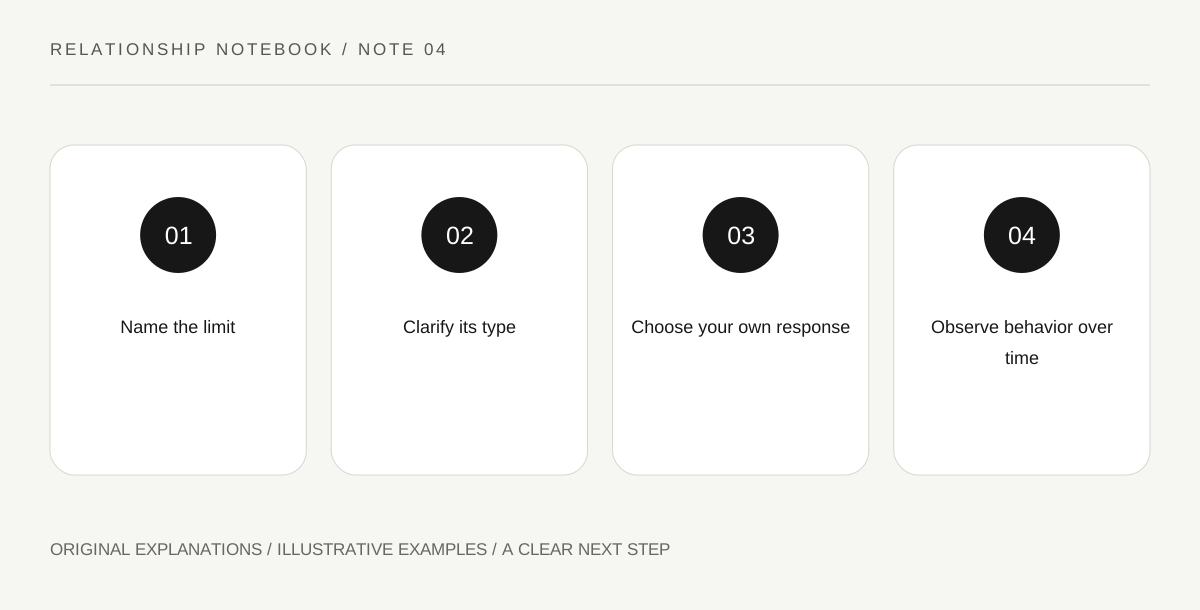
Original explanatory diagram. Read the full method and limitations below.
Identify the limit in your own experience
Start with the situation that leaves you uncomfortable and the value at stake. Perhaps you need sleep, privacy or freedom from insults. Write what you can and cannot participate in. This makes the boundary about your needs and actions rather than a general demand that another person become different.
For example, I will leave a conversation when I am being insulted identifies your participation. You are never allowed to disagree with me attempts to control the other person. A boundary can affect the relationship, but its purpose is protection and choice, not dominance disguised by therapeutic language.
Distinguish a request from a unilateral rule
Could we keep calls before ten? is a request about a shared pattern. I turn my phone off at ten is a statement about your availability. We agree to call on Saturday is a mutual arrangement. These can work together, but they are not the same kind of statement.
Tell the other person which kind you mean. If a preference is negotiable, say so. If a personal limit is firm, do not present it as a bargaining invitation and then punish negotiation. Clear categories reduce confusion without requiring a complicated formal contract for ordinary life.
Choose an action within your control
A boundary needs a response you can actually take, such as ending a call, declining a plan or leaving a relationship. Avoid threats designed to frighten the partner into compliance. The response should relate to protecting the limit rather than imposing unrelated punishment.
Think through practical constraints privately. If leaving a conversation is not safe, or a partner reacts with threats, ordinary boundary scripts may be insufficient. Seek individualized support rather than assume the right wording will create safety. You are not responsible for another person’s decision to intimidate or retaliate.
Allow boundaries to change freely
People can revise a boundary after learning more about their needs or circumstances. A change should be voluntary, not the result of repeated pressure. Explain a new limit clearly when possible and recognize that the partner also has choices about whether the relationship remains workable for them.
Review whether the boundary is being respected through behavior over time. A verbal agreement followed by repeated violations is information. The aim is not a perfect sentence that makes all limits acceptable; it is a clear account of what you choose and what treatment you will participate in.
Illustrative late-night boundary
Alex enjoys talking but needs uninterrupted sleep. Alex says, I won’t answer nonurgent calls after ten. I’d like to plan an earlier call when we both have time. The partner can accept, propose another time or decide the pattern does not suit them. Alex controls the phone’s availability rather than demanding that the partner never be awake late.
Practical checks
Optional checkboxes save only in this browser.
Questions that come up
Can a boundary have consequences?
Yes. A limit can affect whether you stay in a conversation or relationship. The distinction is whether the action protects your participation and wellbeing, rather than functioning as an unrelated punishment to control another person.
What if a partner calls a controlling demand a boundary?
The label does not settle the issue. Examine the behavior: does it preserve their own choices, or restrict your independence through pressure, surveillance or threats? Outside support can help you assess a confusing pattern.
References and scope
These sources support the factual background. Examples and exercises are original illustrative teaching material. References do not imply endorsement.
- loveisrespect: What are my boundaries? — Personal, physical and digital boundaries; changes freely chosen; distinction between boundaries and control.
- loveisrespect: Respect in a healthy relationship — Equality, autonomy, honest communication, supportive behavior and respecting opinions.
- loveisrespect: Disrespectful behavior — Trust, noncontrolling boundaries, personal choices and responding to jealousy or insecurity.