Agree on digital privacy without making surveillance a proof of love
Messaging, photos and location features can create closeness or pressure depending on how they are used. Discuss specific digital choices rather than assuming that a relationship requires unrestricted access. An agreement should preserve independent accounts, freely chosen sharing and the ability to revise a preference.
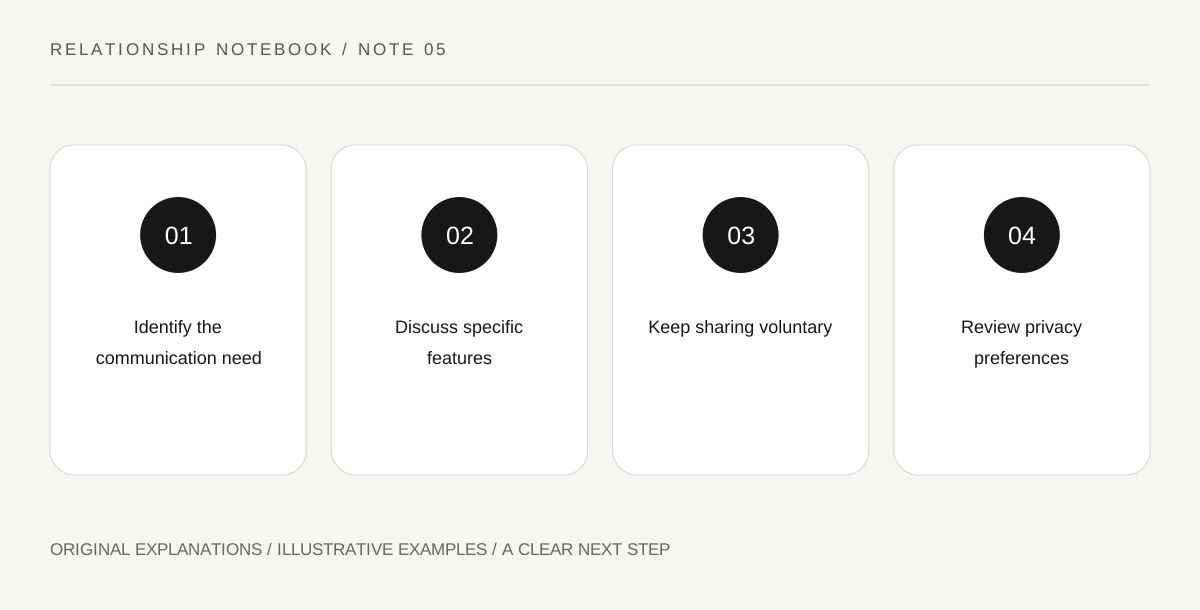
Original explanatory diagram. Read the full method and limitations below.
Separate communication from access
Wanting regular contact does not automatically require a partner’s password or access to their messages. A conversation about when to check in serves a different purpose from reading private conversations. Identify the actual need before proposing a technical feature as its solution.
Make a private list of features you use: read receipts, shared calendars, photo tags and location sharing. For each, ask what it provides and what it exposes. Two people may welcome a shared calendar while preferring separate message accounts. A single all-or-nothing privacy rule can hide those differences.
Discuss posting before the photo is public
Ask before posting a recognizable image or personal detail about the relationship. One person may be comfortable sharing with friends while the other has employment, family or personal reasons for a smaller audience. Their preference does not need to be interpreted as shame about the relationship.
Agree on a practical check: which kinds of images need permission, which audience is acceptable and what to do if someone changes their mind. Deleting a post may not remove copies already made, so avoid promising complete control after publication. Thoughtful consent before sharing is easier than repairing unwanted exposure.
Keep location and response expectations voluntary
A freely chosen location feature for a particular journey differs from continuous tracking demanded under threat of an argument. Similarly, agreeing to send an arrival message differs from requiring instant replies all day. Examine the freedom to decline, not merely whether a feature has a consent button.
Discuss a missed message without assuming wrongdoing. A phone can lose power, work can become busy or a person can choose time away. A check-in arrangement should clarify what to do when plans change, rather than make every delay evidence that someone must prove loyalty.
Recognize when the issue is control
Pressure to share passwords, restrictions on online friendships, threats about images or account impersonation go beyond an ordinary difference in texting style. If you suspect monitoring or retaliation, seek tailored support using a channel you consider safe before making changes that could affect your situation.
For ordinary consensual arrangements, review settings together only if both want to. Each person should retain control over their own accounts. The goal is a clear shared understanding of communication and privacy, not a technical inspection that establishes one partner as the other’s supervisor.
Illustrative photo agreement
Nico likes posting event photos; Sam prefers not to make dating details public. They agree that Nico will ask before posting recognizable couple photos and use a smaller audience when Sam agrees. They keep account passwords private. Later Sam changes a preference about work-related visibility, and they revisit future posts without treating the change as evidence of dishonesty.
Practical checks
Optional checkboxes save only in this browser.
Questions that come up
Is sharing passwords necessary for trust?
No. Trust can coexist with private accounts and independent conversations. Password access does not guarantee honesty, and a demand for access can become a form of control. Discuss the underlying concern rather than treating surveillance as proof.
Can we change a digital agreement later?
Yes. Preferences and circumstances can change. Revisit sharing voluntarily and explain new limits when possible. Earlier agreement does not create permanent entitlement to a person’s location, images or private accounts.
References and scope
These sources support the factual background. Examples and exercises are original illustrative teaching material. References do not imply endorsement.
- loveisrespect: What are my boundaries? — Personal, physical and digital boundaries; changes freely chosen; distinction between boundaries and control.
- loveisrespect: Healthy online boundaries — Freely chosen digital agreements, changing preferences and technology-based control.
- loveisrespect: Disrespectful behavior — Trust, noncontrolling boundaries, personal choices and responding to jealousy or insecurity.