Make consent a continuing conversation between adults
Consent is an active, freely chosen agreement about the specific activity happening now. A relationship label, previous yes or affectionate mood does not replace it. Learn to ask clearly, notice uncertainty, stop when needed and respond to a changed mind without pressure or punishment.
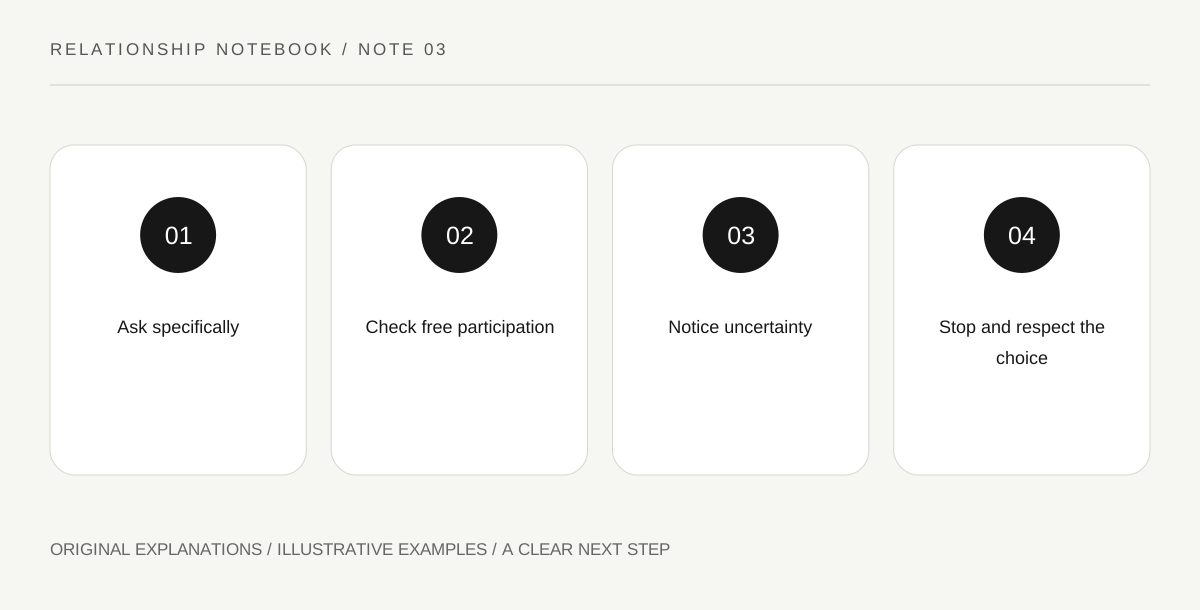
Original explanatory diagram. Read the full method and limitations below.
Ask about the specific activity
A clear question identifies what is being proposed instead of assuming that agreement to one kind of closeness includes everything else. Is this touch welcome? or Would you like to keep going? can open the conversation. The exact wording can be natural while still making the choice understandable.
Discuss preferences at an ordinary calm time as well as in the moment. That can make it easier to ask, but an earlier conversation does not give permanent permission. All adults involved must be capable of choosing; sleep, coercion or intoxication that prevents meaningful agreement cannot be treated as consent.
Look for willing participation, not lack of resistance
A quiet response, freezing, pulling away or sudden silence can signal uncertainty or withdrawal. Stop and check rather than interpret the absence of a loud no as permission. Body language helps you notice a problem, but guessing from a smile is not a substitute for clear mutual agreement.
If you are unsure, pause the activity and ask without making the person reassure you. Would you prefer to stop? should be a genuine option. The aim is not to obtain a particular answer. It is to ensure that continuing is freely wanted by everyone involved.
Respond well to no or a changed mind
A person can withdraw consent after previously agreeing, including during an activity. Stop promptly. Do not argue about the earlier yes, demand a reason or suggest that affection creates a debt. Disappointment is yours to manage without turning it into pressure on the person who set the limit.
A simple response can be, Of course, we can stop. Ask what kind of space or ordinary comfort they want without assuming touch is welcome. Respecting a limit is not a favor that earns future access; it is part of treating another adult as the decision-maker about their own body.
Keep consent separate from relationship bargaining
Avoid making intimacy a condition for kindness, gifts, commitment or forgiveness. Repeatedly asking after a refusal can become coercive even without an explicit threat. If you want different kinds or amounts of intimacy, discuss the compatibility question outside the moment, with each person free to maintain their boundaries.
This article offers general education, not a legal determination about a particular event. Laws and individual circumstances require qualified local information. If an experience was unwanted or unsafe, support can be sought without first finding perfect language or proving that you responded in a particular way.
Illustrative changed preference
Two adults have agreed to kiss. One becomes quiet and turns away. The other stops and asks whether they want to stop. The answer is yes. They stop without debate, and the first person chooses some space. Agreement to kissing earlier did not establish agreement to continue, and neither a gift nor the relationship’s duration changes that.
Practical checks
Optional checkboxes save only in this browser.
Questions that come up
Does a past yes count for the next time?
No. Consent concerns the current activity and can change. Previous affection or sexual activity does not establish present permission. Check what is wanted now and stop if the answer or participation is uncertain.
Does stopping mean someone must explain why?
No. A person does not need to supply an acceptable reason to withdraw consent. You can discuss preferences later if they want, but stopping is not conditional on a debate or an explanation.
References and scope
These sources support the factual background. Examples and exercises are original illustrative teaching material. References do not imply endorsement.
- RAINN: Consent 101 — Clear, voluntary, ongoing consent; respecting withdrawal and stopping when participation is uncertain.
- loveisrespect: What are my boundaries? — Personal, physical and digital boundaries; changes freely chosen; distinction between boundaries and control.
- loveisrespect: Respect in a healthy relationship — Equality, autonomy, honest communication, supportive behavior and respecting opinions.