Talk about jealousy without turning it into monitoring
Jealousy can be an uncomfortable feeling, but it does not authorize control over another adult. Separate the emotion, the story you are telling yourself and the behavior you choose. Discuss a specific concern while preserving independence, privacy and the other person’s freedom to maintain ordinary relationships.
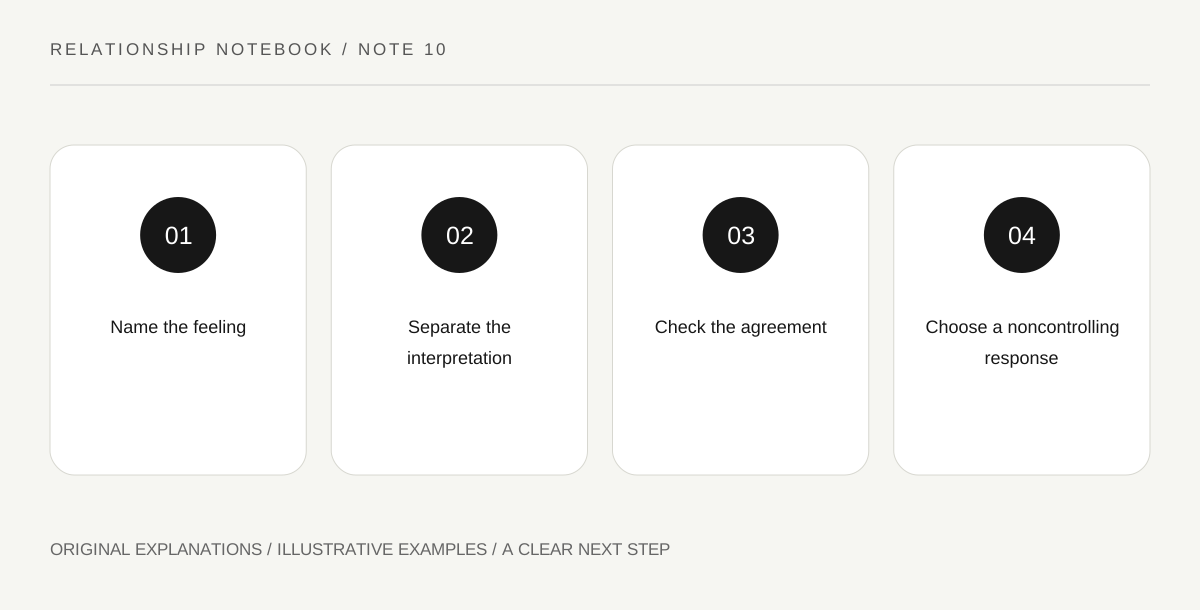
Original explanatory diagram. Read the full method and limitations below.
Name the feeling without treating it as evidence
Feeling jealous does not prove that a partner has broken an agreement. Write what happened, what you felt and what you inferred as separate items. A delayed reply is an event; they must be hiding something is an interpretation. Keeping the distinction visible helps you ask a question rather than begin an interrogation.
You do not have to suppress the emotion or pretend it is attractive. Acknowledge it privately and choose a response after you can think more clearly. The goal is responsible behavior in the presence of a feeling, not the unrealistic promise that jealousy will never occur.
Check the actual agreement
If the concern involves exclusivity or a specific commitment, ask what the two of you have explicitly agreed. A rule assumed privately is not necessarily a shared understanding. Discuss the behavior in concrete terms instead of arguing over a label that each person defines differently.
An agreement can be revisited, but changes should be voluntary. You can decide a relationship arrangement does not suit you without forcing the partner to surrender friendships, clothing choices or private accounts. Compatibility decisions and control are different responses to a mismatch.
Ask for reassurance without demanding surveillance
A request for a calm conversation or a reminder of an agreed plan can be reasonable. Requiring passwords, continuous location proof or repeated photographs to establish innocence places the partner under monitoring. Examine whether the request leaves genuine room to decline and whether it keeps escalating.
Try stating the concern in one sentence and asking one question. Then listen to the answer rather than collecting more and more proof. If reassurance never feels sufficient, consider individual support for the distress instead of making unlimited access the price of remaining in the relationship.
Evaluate behavior on both sides
If a partner has repeatedly lied or violated an agreement, that pattern deserves attention; you do not need surveillance to justify taking your own concerns seriously. Decide what you need, whether trust is being rebuilt through voluntary behavior and whether you wish to continue.
If jealousy leads to threats, isolation or restrictions, seek appropriate support. A partner’s past hurt does not excuse controlling behavior. Your responsibility is your own choices; you cannot cure another person’s insecurity by steadily giving up independence or proving loyalty on demand.
Illustrative delayed reply
After a partner replies late during a friend’s gathering, Quinn feels jealous and imagines rejection. Quinn waits, then says, I felt insecure when I didn’t hear back, but I know a delay doesn’t tell me what happened. Could we clarify what check-ins we both want? They discuss realistic contact without requiring location tracking or access to private messages.
Practical checks
Optional checkboxes save only in this browser.
Questions that come up
Is jealousy proof of love?
No. A feeling does not establish the quality of care, and controlling conduct is not justified by calling it love. Look at respect, freedom and behavior rather than the intensity of possessiveness.
What if trust has already been broken?
You can discuss accountability and decide whether continuing is acceptable. Rebuilding trust, if freely chosen, needs behavior over time. You are not obliged to stay or become a permanent investigator to make the relationship work.
References and scope
These sources support the factual background. Examples and exercises are original illustrative teaching material. References do not imply endorsement.
- loveisrespect: What are my boundaries? — Personal, physical and digital boundaries; changes freely chosen; distinction between boundaries and control.
- loveisrespect: Respect in a healthy relationship — Equality, autonomy, honest communication, supportive behavior and respecting opinions.
- loveisrespect: Disrespectful behavior — Trust, noncontrolling boundaries, personal choices and responding to jealousy or insecurity.
- loveisrespect: Emotional boundaries — Different emotional pacing and trust developing through choices and behavior.