Discuss relationship expectations before relying on a label
Words such as dating, exclusive or serious can carry different meanings for different adults. A useful conversation identifies the actual choices and commitments behind the label. State what you want, ask what the other person wants and notice when agreement is absent rather than filling the gap with assumptions.
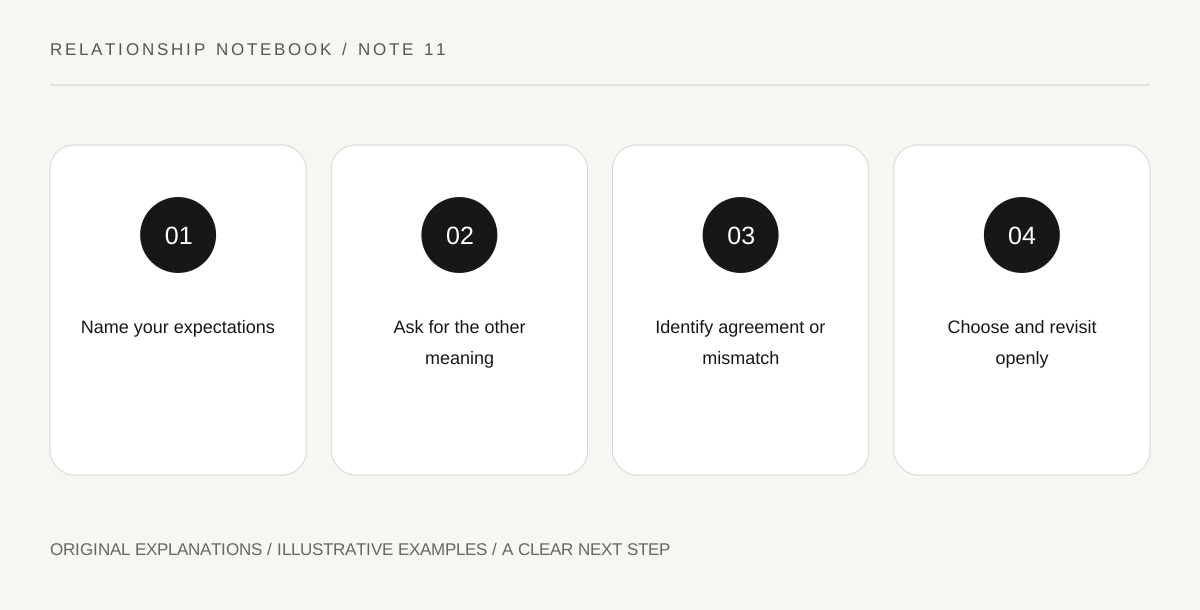
Original explanatory diagram. Read the full method and limitations below.
Describe what the label means to you
Begin with the practical meaning you attach to the relationship. You might want exclusivity, regular time together or a conversation before changing certain plans. These are separate expectations. Saying serious may communicate emotional importance while leaving every practical question unresolved.
Write a few ordinary behaviors that matter to you and distinguish present wishes from long-term possibilities. Wanting a committed relationship now differs from knowing whether you want to share a home later. You can acknowledge uncertainty without pretending that all future decisions are already settled.
Ask about concrete agreements
Ask how the other person understands exclusivity, communication and privacy. Use neutral questions rather than testing whether they supply the same definition without prompting. The purpose is to learn, not to reward a supposedly correct answer that they must infer.
Relationship structures vary, and adults may make different consensual agreements. What matters here is informed, freely chosen understanding among everyone affected. Do not assume one label makes all choices obvious, or that another person has agreed simply because they continued seeing you after you mentioned your preference.
Leave room for a real difference
An honest mismatch can be painful, but it is more useful than a reluctant yes produced by pressure. Each person may want something the other cannot offer. Ask clarifying questions, then consider your own choices without trying to persuade the other person that their stated preference is merely a phase.
A decision to stop dating can follow a respectful conversation. It does not require declaring either adult defective. Equally, you do not have to stay in an arrangement that does not meet your needs merely because the other person has been honest about wanting it. Honesty supplies information, not an obligation to accept incompatibility.
Revisit when circumstances change
An agreement is not permanent consent to every future change. Discuss a proposed revision before acting on it where the agreement requires that. A job move, changing availability or a new preference may create a reason to revisit expectations; it does not automatically cancel earlier commitments without conversation.
At the end, summarize what is agreed, what remains open and what decision follows. Keep the summary proportionate and private. You do not need a legal-looking contract for an ordinary conversation, but both should be able to explain the same practical understanding afterward.
Illustrative label clarification
Two adults have been dating for several weeks. One says they would like to be exclusive, then explains what that means to them. The other wants to continue dating casually. They clarify that this is a present difference, not a promise to change later. The first person decides the arrangement does not suit them, and they end dating without bargaining over affection.
Practical checks
Optional checkboxes save only in this browser.
Questions that come up
Does using the same label mean we agree?
Not necessarily. Ask about the behaviors and commitments the label represents. Two people can use exclusive or serious while assuming different communication, privacy or future expectations.
Is it unromantic to discuss expectations directly?
Direct discussion can feel awkward, but it allows informed choices. You can use warm ordinary language while still asking clear questions. Leaving important assumptions unspoken does not make them more reliably shared.
References and scope
These sources support the factual background. Examples and exercises are original illustrative teaching material. References do not imply endorsement.
- loveisrespect: What are my boundaries? — Personal, physical and digital boundaries; changes freely chosen; distinction between boundaries and control.
- loveisrespect: Respect in a healthy relationship — Equality, autonomy, honest communication, supportive behavior and respecting opinions.
- loveisrespect: Emotional boundaries — Different emotional pacing and trust developing through choices and behavior.