Turn an unmet need into a request someone can answer
A partner cannot respond clearly to a need that remains hidden inside a complaint. Identify the experience you want, describe the situation specifically and ask for one possible action. The request should invite a genuine answer, including a different proposal, rather than test whether the other person can read your mind.
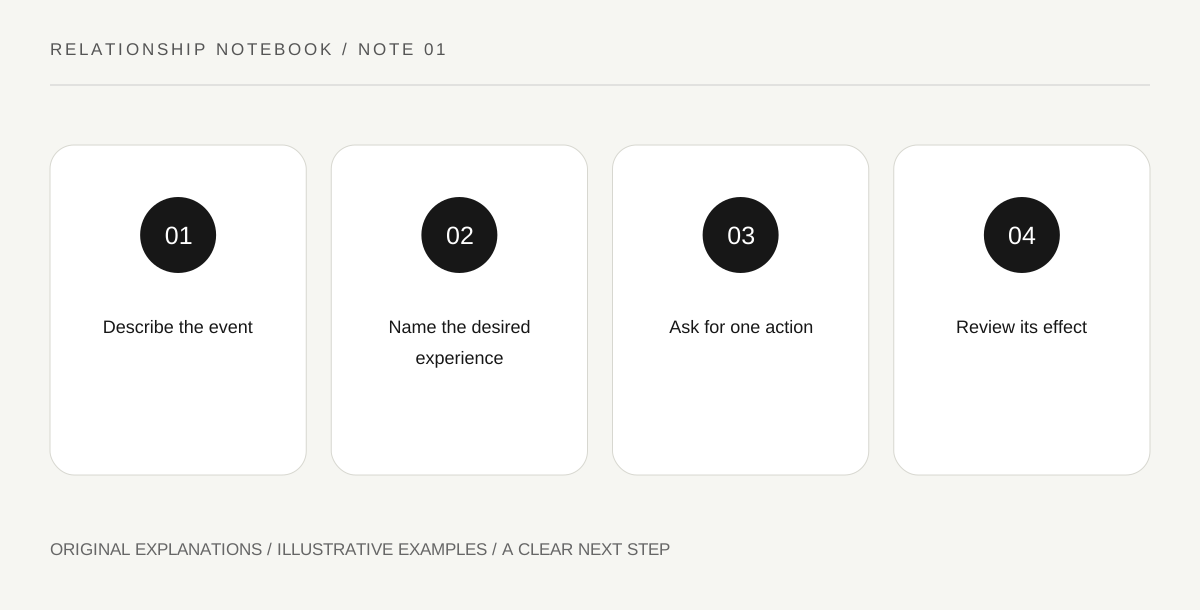
Original explanatory diagram. Read the full method and limitations below.
Separate what happened from its meaning
Write the observable event first: we had no uninterrupted conversation after dinner this week. Then write the meaning you attached to it: perhaps I am unimportant. The meaning may feel convincing, but it is still an interpretation. Separating the two leaves room to learn whether work, fatigue or another factor also contributed.
This distinction does not require dismissing your feelings. You can feel lonely while remaining uncertain about the other person’s motives. Start from what you know and name the effect on you. Avoid presenting an inferred intention as an established fact the partner must admit before discussion can begin.
Name the experience you want
A need for connection can become confused with one preferred method, such as a long phone call every night. Ask what the method would provide: attention, reliability, affection or a shared moment. Naming that experience creates more possible solutions while preserving the importance of the need.
Try completing I would like more… without naming a particular behavior. Then list two ways that could happen. This is a private preparation exercise, not a negotiation tactic. You are identifying what matters so you can distinguish a meaningful alternative from an offer that does not address the issue.
Ask for one concrete action
Could we put our phones away for dinner on Wednesday? is answerable. Be more caring leaves the partner guessing about the expected behavior. Give the request a clear occasion and scope, and ask at a time when both people can attend rather than during another demanding task.
An answer might be yes, no or a proposed adjustment. If Wednesday is impossible, ask what would work instead. A request becomes pressure when refusal produces punishment or repeated demands until agreement. You can explain that an ongoing unmet need affects your relationship decisions without claiming ownership of the other person’s choices.
Check the experience after trying it
After an agreed experiment, ask what each person noticed. Did the dinner feel connected? Was the chosen time realistic? A completed action can still miss the underlying need, while an imperfect attempt may reveal a more workable routine. Keep the review about the experience rather than a score of obedience.
If the same need repeatedly goes unanswered, notice the pattern. Better wording cannot guarantee willingness, compatibility or care. You may choose a broader conversation or appropriate individual support. The exercise helps make a need visible; it does not make you responsible for producing every response you hope to receive.
Illustrative connection request
Rae feels distant after several distracted evenings. Instead of saying You never care, Rae says, I miss having your attention. Could we take a short walk together on Thursday without checking messages? Morgan cannot manage Thursday but proposes Saturday morning. They agree to try it and later discuss whether the walk gave them the connection Rae was seeking.
Practical checks
Optional checkboxes save only in this browser.
Questions that come up
Does using I feel make any sentence constructive?
No. I feel that you are selfish still makes a global judgment. Name an actual feeling and a specific event, then ask for an observable action. The wording should clarify the issue, not conceal an accusation.
What if the answer is always no?
A repeated refusal is information about willingness or compatibility, not proof that you failed to find the perfect phrase. Consider the broader pattern and what you need from the relationship, with support if useful.
References and scope
These sources support the factual background. Examples and exercises are original illustrative teaching material. References do not imply endorsement.
- NHS: Maintaining healthy relationships and mental wellbeing — Listening, check-ins, time apart, boundaries, stress, conflict and permission to leave an unhealthy relationship.
- loveisrespect: Respect in a healthy relationship — Equality, autonomy, honest communication, supportive behavior and respecting opinions.
- Gottman Institute: The Four Horsemen and antidotes — Specific complaints, respectful openings, taking responsibility and pausing an overwhelmed conflict discussion.