Listen to a partner’s problem before offering a solution
Advice can miss the point when someone first needs to feel understood. Listening does not require agreeing with every interpretation or solving the problem. Find out what kind of support is wanted, reflect the important part and check whether practical ideas would help before offering them.
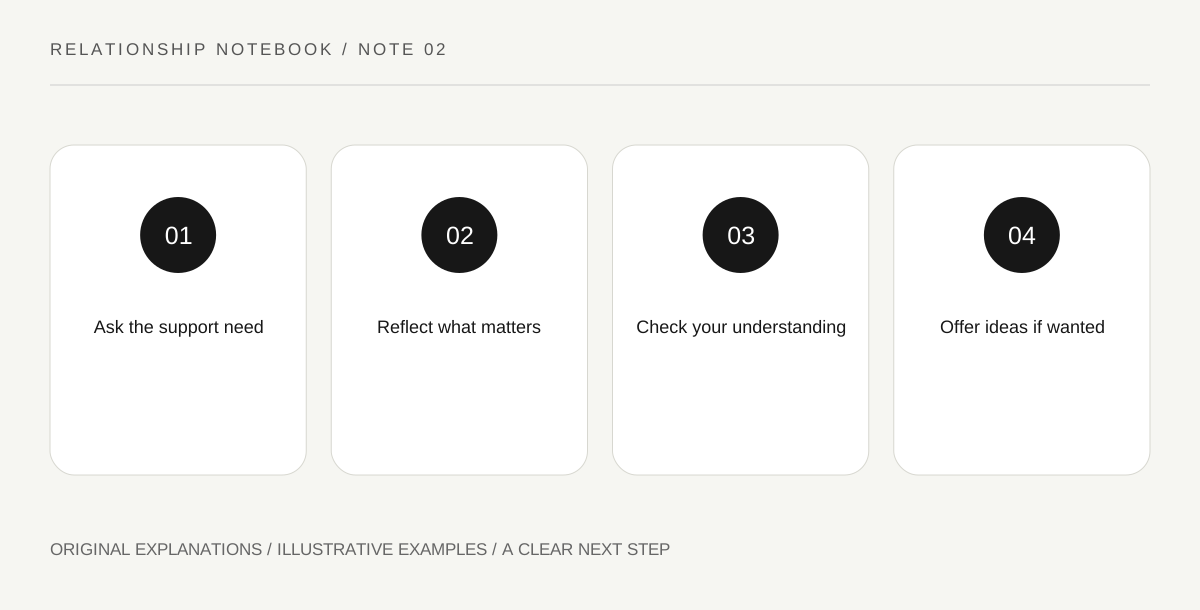
Original explanatory diagram. Read the full method and limitations below.
Ask what kind of conversation this is
A person sharing a difficult day may want listening, help choosing an action or company while doing something else. Ask, Would you like me to listen, think through options with you, or help with something practical? The answer can change as the conversation develops, so treat it as a starting point.
Do not turn the question into a rigid menu delivered mechanically. If the person is upset, a simple I’m here; what would help? may fit better. The useful principle is to check the support needed instead of assuming that affection always means immediately proposing a solution.
Reflect the meaning rather than repeat mechanically
A useful reflection summarizes the experience: You felt overlooked when the plan changed without asking you. It shows what you heard and lets the speaker correct it. Repeating every word can feel artificial, while adding an elaborate theory about their psychology goes beyond what they told you.
Use tentative language when you are uncertain: It sounds as though… or Have I understood that…? A correction is a successful part of listening. If the speaker says the main issue was embarrassment rather than exclusion, revise your understanding instead of defending the accuracy of your first summary.
Separate empathy from endorsing every conclusion
You can acknowledge that an event hurt without confirming an unsupported claim about someone else’s motives. That sounds upsetting differs from Your colleague definitely intended to humiliate you. The first attends to the person’s experience; the second supplies certainty you may not possess.
Ask a gentle clarifying question about the event if it would help, but avoid cross-examining the person as if they must prove a right to be distressed. Listening is neither a courtroom nor a promise to validate every possible interpretation. Aim for an accurate understanding of what matters to them.
Offer ideas with permission and limits
After the person feels heard, ask whether they want to consider options. Offer one idea, then pause. A rapid list can shift the conversation toward your expertise rather than their priorities. If they decline advice, respect that and ask whether another kind of support would help.
Your capacity also matters. You can say, I can listen now for a little while, then I need to finish my work. Suggest another time or another source of support when appropriate. Caring does not require unlimited availability or making yourself the only person they can turn to.
Illustrative difficult-day conversation
Jordan describes a disappointing meeting. Lee begins to suggest an email, then asks whether advice would help. Jordan says they first want to talk. Lee summarizes that the last-minute change felt dismissive. Jordan corrects one point, and Lee listens. Later Jordan asks for help drafting a question, so the conversation moves into practical planning by agreement.
Practical checks
Optional checkboxes save only in this browser.
Questions that come up
Is listening the same as agreeing?
No. You can understand and acknowledge distress while remaining uncertain about an interpretation or disagreeing with a proposed action. State that distinction respectfully instead of using disagreement to dismiss the feeling.
What if I know an obvious solution?
Check whether the person wants ideas and whether you understand the real problem. What looks obvious from outside may ignore constraints. Offering one suggestion after permission is often more useful than insisting on an immediate fix.
References and scope
These sources support the factual background. Examples and exercises are original illustrative teaching material. References do not imply endorsement.
- NHS: Maintaining healthy relationships and mental wellbeing — Listening, check-ins, time apart, boundaries, stress, conflict and permission to leave an unhealthy relationship.
- loveisrespect: Respect in a healthy relationship — Equality, autonomy, honest communication, supportive behavior and respecting opinions.
- loveisrespect: Support systems at home — Outside support, practical and emotional help, privacy preferences and communicating support needs.