End a relationship clearly while respecting your own safety
A breakup does not require both people to agree that it is justified. You can communicate the decision clearly and avoid offering false hope to soften the moment. The method should fit your circumstances and safety, with practical arrangements handled separately from pressure to reconsider.
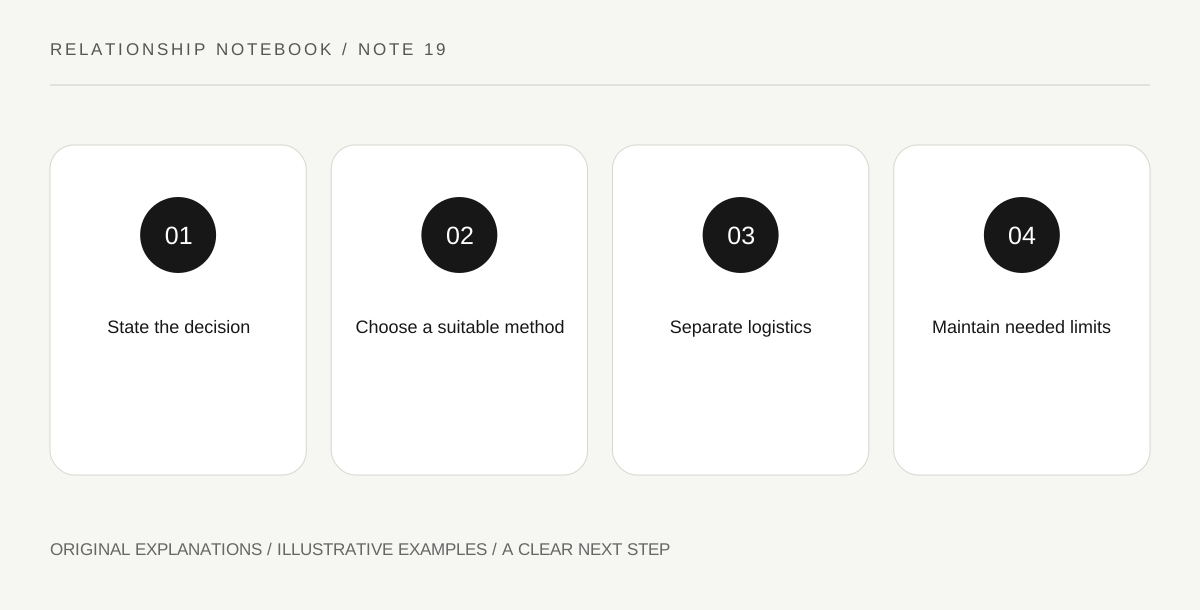
Original explanatory diagram. Read the full method and limitations below.
Distinguish a decision from a negotiation
If you have decided to end the relationship, state that plainly. I have decided to end our relationship is clearer than I might need a little space when you do not intend to return. Ambiguous wording may feel gentler in the moment while leaving the other person waiting for a different outcome.
You can offer a brief honest explanation without presenting a case they must accept. The other person may disagree, feel hurt or ask questions. Their feelings matter, but they do not create authority to veto your decision. You are not required to continue dating until the explanation satisfies them.
Choose a method suited to the situation
An in-person conversation may fit some relationships, while a call or message may be more appropriate in others. There is no universal courtesy rule that requires being alone with someone who frightens you. Consider your actual circumstances, support and practical constraints.
If you anticipate threats, coercion or retaliation, seek individualized safety support rather than rely on a general breakup script. Do not assume that announcing every plan or location is safer. The priority is a method you can use without being pressured into a situation that increases danger.
Handle practical matters in a bounded way
Belongings, shared plans or living arrangements may require later coordination. Identify the practical issue and an appropriate channel rather than use every logistical message to reopen the relationship discussion. Complex housing, financial or legal questions need qualified local information beyond this article.
Set communication limits you can uphold. For example, you may choose one channel for arranging an exchange of belongings. Do not promise friendship or constant emotional support if you do not want or cannot offer it. A wish to reduce immediate pain should not create a new commitment you know is false.
Allow grief without reopening by default
You may feel sadness or doubt after a decision that still fits your needs. Seek support from trusted people and give yourself time before interpreting every painful feeling as evidence that the breakup was wrong. The former partner can also seek support beyond you.
If contact becomes threatening or persistent against your wishes, treat that behavior seriously and seek appropriate help. You do not need to keep answering to prove kindness. Ending a relationship can be respectful while remaining firm, and no communication technique guarantees that the other person will respond calmly.
Illustrative clear ending
One adult says, I have decided to end our relationship. I appreciate what we shared, but I do not want to continue dating. They do not add perhaps later when they do not mean it. They arrange a separate message about returning a book and decline repeated conversations intended to change the decision. The example assumes no immediate safety threat.
Practical checks
Optional checkboxes save only in this browser.
Questions that come up
Do I owe an in-person breakup?
There is no universal requirement. Consider the relationship and your safety. A remote method can be appropriate, especially if an in-person conversation would expose you to pressure, threats or danger.
Can someone refuse to accept the breakup?
They can disagree or feel hurt, but a relationship requires willing participation. Your decision does not depend on their approval. Set appropriate contact limits and seek support if their behavior becomes coercive or threatening.
References and scope
These sources support the factual background. Examples and exercises are original illustrative teaching material. References do not imply endorsement.
- NHS: Maintaining healthy relationships and mental wellbeing — Listening, check-ins, time apart, boundaries, stress, conflict and permission to leave an unhealthy relationship.
- loveisrespect: What are my boundaries? — Personal, physical and digital boundaries; changes freely chosen; distinction between boundaries and control.
- loveisrespect: Ending unhealthy relationships — Recognizing that ending a relationship can be appropriate and considering individual safety.