Respond to a partner’s good news without taking over the moment
Connection is built during ordinary positive moments as well as difficult ones. When a partner shares good news, make room for what it means to them before adding your own story or practical concerns. You can show interest without exaggerating, making promises or assuming they want a public celebration.
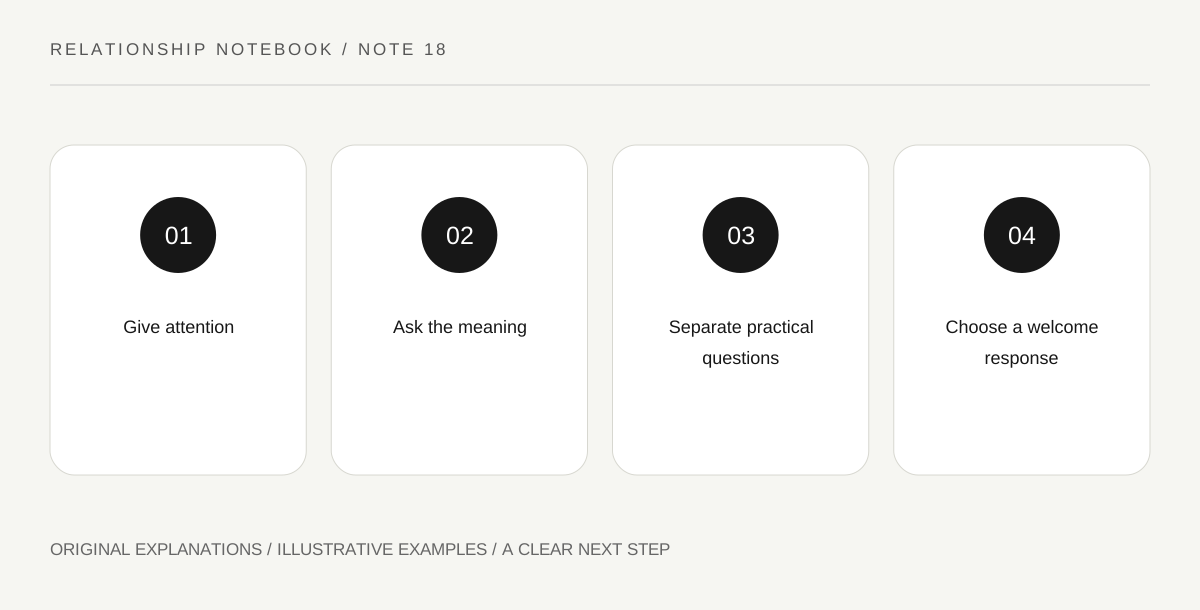
Original explanatory diagram. Read the full method and limitations below.
Notice the invitation to share
A message about finishing a project or enjoying a new activity may be an invitation for attention, even if the event seems small to you. Pause if possible and acknowledge the news. If you cannot attend now, say when you can return rather than give a distracted response that ends the moment.
You do not have to perform excitement you do not feel. A sincere question and attentive listening can communicate interest. The point is to make room for the person’s experience rather than decide whether the achievement qualifies as objectively important enough to discuss.
Ask what the event means to them
What part are you happiest about? or How did it feel when you finished? invites the person’s perspective. They may value relief, recognition or a new opportunity. Asking prevents you from assuming that the visible result is the only meaningful part.
Avoid immediately turning the event into your own comparable success. Your experience may become relevant later, but first let the partner tell their story. A conversation can include both people without requiring an instant exchange of equally impressive achievements.
Separate celebration from practical decisions
Good news may create logistical questions, such as a new schedule or travel. Those questions matter, but opening with every possible drawback can make the person feel that joy is unwelcome. Acknowledge the positive experience before proposing a separate time to discuss consequences.
Do not promise support you cannot offer just to sound enthusiastic. You can say I’m glad this opportunity matters to you, and I’d like us to talk about the scheduling changes. Warmth and realistic limits can coexist. Neither requires suppressing a genuine practical concern indefinitely.
Ask before expanding the audience
A partner may want to tell family or colleagues themselves, or may not be ready for public attention. Ask before posting, making an announcement or organizing a surprise gathering. Their news remains theirs to share, even when you are proud of them.
Choose a celebration that fits what they want: a message, quiet meal, walk or no special event. An attentive response does not need to be expensive or visible. Later, remember the detail they cared about and ask a follow-up. That continuity can show that you listened beyond the first congratulatory phrase.
Illustrative project milestone
Em completes a long creative project and tells Taylor. Taylor puts down the phone and asks which part feels most satisfying. Em describes finally solving a difficult section. Taylor asks whether Em wants to celebrate privately or tell friends. Em chooses a quiet meal. They discuss the project’s future scheduling implications another day rather than combine celebration with every practical question.
Practical checks
Optional checkboxes save only in this browser.
Questions that come up
What if I do not understand the achievement?
Ask a simple interested question. You do not need specialist knowledge to hear why the event matters. Avoid pretending expertise or making a judgment before the person has explained their own experience.
Do I have to ignore a serious practical concern?
No. Acknowledge the positive moment and arrange a suitable discussion of the concern. If action is immediately necessary, state that clearly while still recognizing what the news means to the person.
References and scope
These sources support the factual background. Examples and exercises are original illustrative teaching material. References do not imply endorsement.
- NHS: Maintaining healthy relationships and mental wellbeing — Listening, check-ins, time apart, boundaries, stress, conflict and permission to leave an unhealthy relationship.
- loveisrespect: What are my boundaries? — Personal, physical and digital boundaries; changes freely chosen; distinction between boundaries and control.
- loveisrespect: Respect in a healthy relationship — Equality, autonomy, honest communication, supportive behavior and respecting opinions.
- loveisrespect: Healthy online boundaries — Freely chosen digital agreements, changing preferences and technology-based control.