Manage a recurring difference without declaring one personality correct
Some disagreements return because partners prefer different levels of sociability, planning or quiet. The aim may be a workable arrangement rather than proving that one preference is objectively superior. Identify the recurring situation, understand what each preference provides and test a plan with room for review.
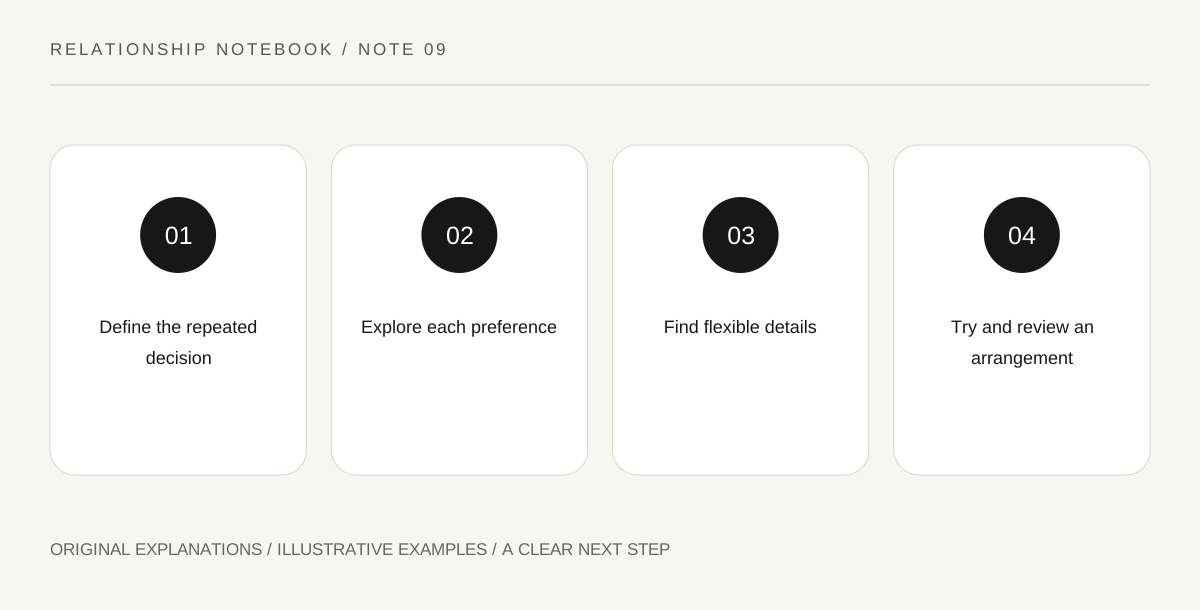
Original explanatory diagram. Read the full method and limitations below.
Define the recurring situation precisely
We disagree about every weekend is too broad to design a useful response. A more specific version is that one person wants a social plan on both days while the other wants one unplanned day at home. The clearer description reveals what actually competes for the same time.
List recent examples without turning the exercise into a scorecard. Look for the repeated decision, not every flaw you associate with the partner. A preference for planning is not automatically controlling, and a preference for flexibility is not automatically careless. The behavior and its effect matter.
Ask what the preference protects
A social plan may provide friendship, energy or continuity with a community. An unplanned day may provide rest, autonomy or relief from a demanding week. Ask what matters most about each preference rather than assume the surface plan tells the whole story.
Understanding does not require adopting the same preference. You can recognize that a routine gives someone security while still finding it restrictive for yourself. The purpose of asking is to identify the important parts, which makes it easier to distinguish a meaningful compromise from a solution that removes everything one person values.
Separate firm limits from flexible details
Each person can identify what is essential and what could vary. Perhaps one needs a quiet morning, but the exact day is flexible. The other needs regular friend contact, but it need not include the partner every time. Independence can create options that a together-or-nothing assumption hides.
Do not treat bodily autonomy, freedom from intimidation or basic respect as bargaining chips. This exercise concerns ordinary preference differences between adults who can choose freely. If the apparent disagreement involves coercion or fear, a compromise model may conceal the more serious issue.
Try an arrangement and review its cost
An illustrative trial might reserve Saturday morning for separate activities and choose one shared social event later. State what each person is actually agreeing to and when to revisit it. Avoid pretending that equal hours automatically produce equal satisfaction or effort.
At review, ask whether the plan protected the important needs and what felt burdensome. A recurring difference may remain, even with better management. Compatibility is not guaranteed by good technique. You can appreciate the other person and still decide that the available arrangements do not meet your needs.
Illustrative weekend difference
One partner enjoys spontaneous invitations; the other needs a predictable rest period. They agree to leave Sunday morning unplanned and discuss Saturday invitations individually. Neither must attend every event. After two weekends they find the rest period useful but the late notice stressful, so they adjust the check-in time instead of debating which temperament is more mature.
Practical checks
Optional checkboxes save only in this browser.
Questions that come up
Does a recurring disagreement mean the relationship has failed?
Not necessarily. Some differences need ongoing management. Look at whether both people can discuss them respectfully and whether the resulting arrangements are acceptable, rather than expecting every preference to become identical.
Must every compromise be exactly equal?
No. Equal quantities do not automatically mean fairness. Consider effort, constraints, choice and the importance of the need. A workable arrangement should be freely acceptable rather than merely symmetrical on paper.
References and scope
These sources support the factual background. Examples and exercises are original illustrative teaching material. References do not imply endorsement.
- loveisrespect: What are my boundaries? — Personal, physical and digital boundaries; changes freely chosen; distinction between boundaries and control.
- loveisrespect: Respect in a healthy relationship — Equality, autonomy, honest communication, supportive behavior and respecting opinions.
- Gottman Institute: Six conflict-management skills — Conflict dialogue, repair, influence and recognizing that recurring differences may need management.