Recognize when relationship advice needs to give way to individual support
Ordinary communication exercises assume that both adults can disagree freely. Threats, isolation, sexual pressure or monitoring change that assumption. Look at the pattern of behavior and its effect on your choices rather than search for a perfect label or a script that will make another person stop controlling you.
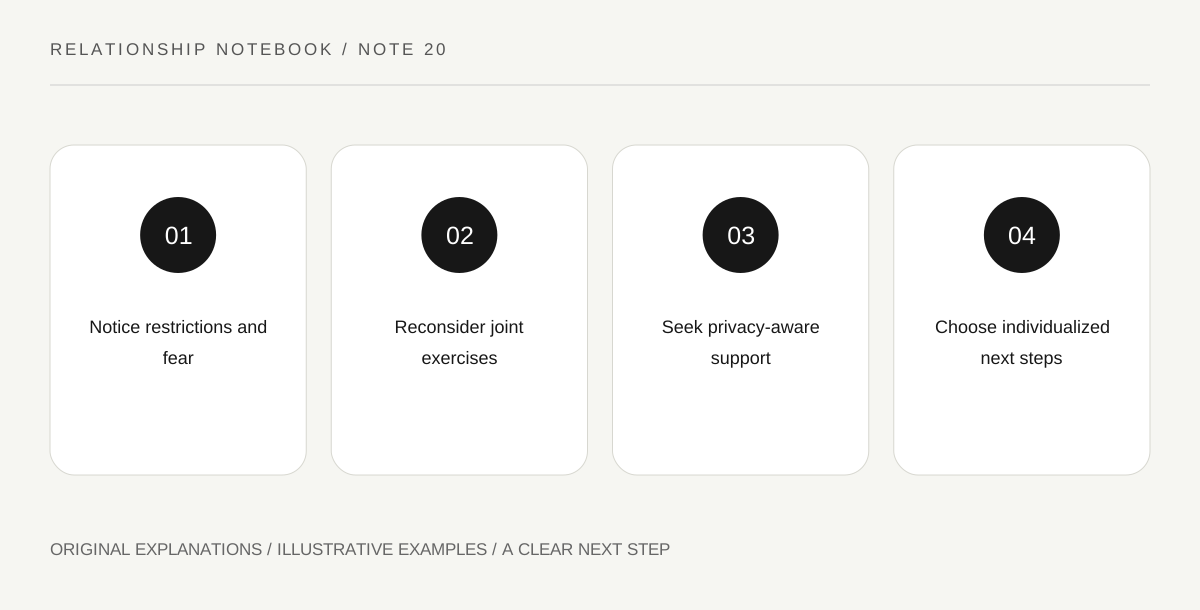
Original explanatory diagram. Read the full method and limitations below.
Look at freedom and fear
Ask whether you can say no, maintain friendships, keep appropriate privacy and make everyday choices without punishment. A disagreement about preferences differs from a pattern that makes you afraid to act independently. You do not need visible injury for a restriction or threat to matter.
Consider what happens after you express a limit. Does the person listen, disagree respectfully or retaliate through intimidation, humiliation or interference with your life? Focus on observable behavior. A charming explanation or an intense declaration of love does not cancel the effect of repeated control.
Do not make joint discussion the first requirement
Advice to confront the issue, disclose everything or practise compromise can be unsuitable when one person uses information to control the other. You are not obliged to try every communication technique before seeking support. The inability to speak safely is itself relevant information.
A trusted person or a specialist relationship-abuse service can help you consider your circumstances. You can ask for support while uncertain about the label and without committing to an immediate decision. Avoid judging your situation against a more dramatic example before allowing yourself to be concerned.
Consider privacy when looking for help
Technology can expose searches, messages and location information. Private browsing does not guarantee that device or account activity is invisible. If you suspect monitoring, consider a way to seek help that fits your circumstances and discuss technology questions with a knowledgeable support service.
Do not assume that abruptly changing passwords, deleting records or disabling a feature is always the safest first step. The effect depends on access, notifications and the person’s likely response. General articles cannot assess those details; individualized guidance is more useful than a universal digital escape checklist.
Keep the responsibility in the right place
The person choosing threats or coercion is responsible for that behavior. You did not cause it by failing to explain a boundary elegantly. You can make choices about support and next steps at a pace that reflects your circumstances, while taking immediate danger seriously.
If you are helping someone else, listen, avoid blame and ask what support they want. Do not take over or make promises you cannot keep. Appropriate emergency assistance may be needed in immediate danger. This article does not provide a risk assessment, legal instruction or a guaranteed plan; it points toward support tailored to the individual.
Illustrative change in approach
A reader plans to use a calm communication script about phone privacy. They realize that previous refusals led to threats and interference with friendships. Instead of assuming a better sentence will solve it, they choose to talk privately with a trusted support person and explore specialist guidance. The next step changes because free disagreement is absent, not because the reader failed at communication.
Practical checks
Optional checkboxes save only in this browser.
Questions that come up
Do I need to be certain it is abuse before seeking help?
No. You can discuss troubling behavior and uncertainty with a suitable support service or trusted person. Seeking information does not require proving a label or deciding immediately what to do.
Can I fix controlling behavior by communicating better?
Clear communication cannot guarantee another person will stop coercion. Responsibility for that behavior belongs to the person choosing it. Seek support appropriate to your circumstances rather than make your wording the condition for safety.
References and scope
These sources support the factual background. Examples and exercises are original illustrative teaching material. References do not imply endorsement.
- RAINN: Consent 101 — Clear, voluntary, ongoing consent; respecting withdrawal and stopping when participation is uncertain.
- loveisrespect: What are my boundaries? — Personal, physical and digital boundaries; changes freely chosen; distinction between boundaries and control.
- loveisrespect: Respect in a healthy relationship — Equality, autonomy, honest communication, supportive behavior and respecting opinions.
- loveisrespect: Healthy online boundaries — Freely chosen digital agreements, changing preferences and technology-based control.
- loveisrespect: Support systems at home — Outside support, practical and emotional help, privacy preferences and communicating support needs.
- loveisrespect: Ending unhealthy relationships — Recognizing that ending a relationship can be appropriate and considering individual safety.
- loveisrespect: Online safety while dating — Device and account monitoring risks; private browsing does not guarantee invisible activity; individualized technology safety support.